How to Study a Textbook Chapter Effectively Without Rereading Everything
Learn how to study a textbook chapter with a simple active-reading method. Preview the chapter, ask better questions, recall key ideas, and review without rereading every page.
A textbook chapter can be long, slow, and difficult to remember. Many students read from the first page to the last, highlight half the chapter, and then discover that they cannot explain the main idea without looking again. That does not mean you are bad at studying. It usually means the reading process was too passive.
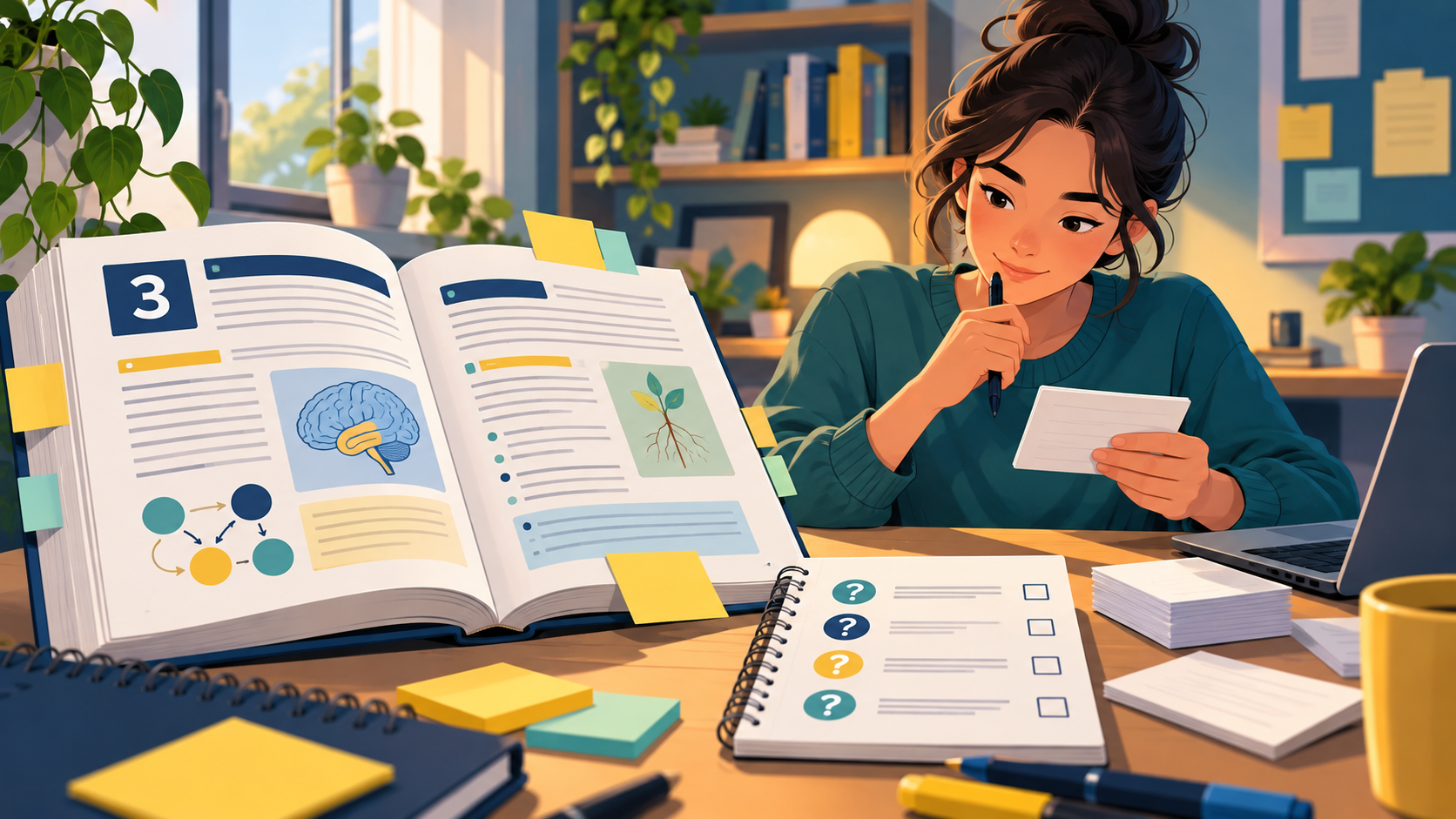
A better method treats the textbook as a guide for questions, examples, and practice. You preview the chapter, read it in small pieces, close the book to recall what you learned, and return later to the parts that still feel unclear. This approach helps you study a textbook chapter effectively without spending all day rereading.
Why rereading a chapter feels useful but often fails
When you reread a familiar page, it looks easy because your eyes recognize the words. Recognition can feel like learning, but an exam usually asks you to produce an answer without the page in front of you. The gap between “this looks familiar” and “I can explain it alone” is where many students lose marks.
You do not have to stop reading. You need to add small moments of effort. After a section, close the book and ask what it was about, how it connects to the last section, and what example proves the idea. If you cannot answer, reopen the book for a focused check rather than starting the whole chapter again.
Preview the textbook chapter before reading
Spend five to ten minutes getting the shape of the chapter. A preview gives your brain a simple map and helps you decide which details deserve attention. It also makes a long chapter feel like a set of smaller jobs.
- Read the chapter title, introduction, learning goals, summary, and key terms.
- Scan the headings, subheadings, diagrams, tables, examples, and review questions.
- Notice words in bold or italics, but do not assume every highlighted word is equally important.
- Estimate how many sections you need to finish and divide them across your available sessions.
During the preview, write two or three questions you expect the chapter to answer. Turn headings into questions when possible. “Types of memory” can become “How are the types of memory different, and when is each used?” A question gives your reading a purpose.
Read one small section at a time
Do not treat a 40-page chapter as one sitting. Choose one heading or a few pages and finish that section before moving on. Small sections make it easier to stop, recall, and notice confusion before it spreads to the next topic.
Use a question while you read
Keep one question in mind for the section. Look for the main claim, the reason behind it, the steps in a process, or the evidence used to support it. You are not trying to memorize every sentence. You are trying to understand the job that section performs in the chapter.
Stop and explain before turning the page
After a few pages, look away from the book. Explain the idea in plain language as if a classmate asked you about it. Include one example and one connection to an earlier topic. If your explanation is only a copied sentence, try again with simpler words.
- What was the main idea of this section?
- What two or three details support or explain it?
- What example, diagram, formula, or case makes it easier to understand?
- What part would I still get wrong on a quiz?
Use an active reading cycle
A simple cycle based on active reading methods works for most subjects. You can remember it as preview, question, read, recall, and review. Some students know a similar version as SQ3R. The label matters less than actually closing the textbook and retrieving the idea.
- Preview: scan the structure and learning goals.
- Question: turn headings and objectives into questions.
- Read: work through one short section with the questions in mind.
- Recall: close the book and answer from memory.
- Review: check the gaps, correct them, and schedule a later return.
Keep the recall step short at first. Even two minutes of writing from memory is more informative than another ten minutes of comfortable rereading. Over time, you will learn which parts need a second look.
Take fewer, better notes
Notes should help you remember and use the chapter later. They are not a second copy of the textbook. Write short phrases, questions, examples, connections, and warnings about common confusion. Leave space to add a correction after practice.
A useful note might say “osmosis moves water across a membrane because of concentration difference” followed by a quick example. A weak note might copy an entire paragraph without showing what the paragraph means. If a sentence is important, rewrite it in your own words before moving on.
If you prefer digital notes, an AI note-taking workspace can help you organize the chapter after you understand it. Use the tool to clean up a rough outline or find missing headings, but keep the thinking step yours. You should still be able to close the source and explain the idea.
Study diagrams, examples, and questions actively
Textbooks often hide the most useful information in diagrams, worked examples, tables, and questions at the end of a chapter. Do not skip them because the paragraphs look easier. They often show how the ideas work in a real problem.
For diagrams and processes
Cover the labels and redraw the diagram from memory. Then explain what changes first, what happens next, and why the steps are connected. For a cycle, practice starting from more than one point so you understand the whole process instead of memorizing a picture.
For worked examples
Read the problem, cover the solution, and decide what you would do first. Try the steps yourself before checking the author’s method. If your answer differs, compare the reason for the difference rather than simply copying the final number.
For chapter questions
Treat review questions as a first practice test. Answer without looking, mark the ones you missed, and use those misses to guide your next session. Questions are especially useful because they show the level of detail the author thinks matters.
Turn the chapter into a one-page study guide
After reading, make a one-page guide from memory. Put the chapter’s main idea at the top, then add the key terms, steps, comparisons, formulas, diagrams, and questions you need to answer. Do not worry about making it pretty. It is a thinking tool, not a poster.
- Write three to five big ideas, not a list of every detail.
- Add one example for each difficult idea.
- Mark terms you can define and terms you only recognize.
- Add questions that you missed during recall or practice.
- Leave a small “still confusing” box for the next class or office hour.
The act of building the guide reveals what you forgot. If the page is empty, that is useful information. Open the textbook only to repair a specific gap, then close it and try the explanation again.
Use spaced review instead of one long reread
A chapter should not disappear after the day you finish it. Schedule short returns so you practice remembering after a gap. You might review the same chapter later that day, two days later, one week later, and again before the exam. Adjust the spacing when the material is easy or difficult.
- First return: answer the main questions without notes.
- Second return: redraw key diagrams or redo important examples.
- Third return: mix questions from this chapter with another chapter.
- Exam review: focus on mistakes, links between chapters, and likely question types.
A 45-minute textbook study session
When you do not know where to start, use this simple session. The timer is only a boundary. Stop when the work is complete, even if that takes a little more or less time.
- Five minutes: preview one section and write two questions.
- Fifteen minutes: read with the questions in mind and mark only useful details.
- Ten minutes: close the book and write what you remember.
- Ten minutes: check the gaps and answer the chapter questions.
- Five minutes: write the next review date and one question to revisit.
If the chapter is very difficult, use two or three sessions instead of forcing the whole thing into one sitting. A calm return tomorrow is better than a late-night session that leaves you too tired to understand the next class.
What to do when a textbook chapter is confusing
First, name the exact problem. Is the vocabulary new? Is there a missing step in the example? Do two ideas look similar? Once you can name the problem, you can choose a better fix than simply rereading.
- Look at the chapter summary and headings to rebuild the big picture.
- Find one simpler explanation from class notes, a trusted course resource, or your teacher.
- Work through a single example slowly and explain each step.
- Write a question for class, office hours, or a study partner.
- Return to the original section after you understand the missing idea.
Textbook study mistakes to avoid
Efficient reading is not about rushing through the chapter. It is about spending more attention on the parts that improve understanding and recall.
- Reading from page one to the end without previewing the purpose.
- Highlighting full paragraphs instead of writing a short reason why a point matters.
- Making notes while looking at the answer and never testing yourself later.
- Skipping figures, tables, examples, and end-of-chapter questions.
- Waiting until exam week to discover which chapters you never understood.
Questions about studying textbook chapters
Should I read the whole textbook chapter?
Follow your course requirements, but read with a purpose. Preview the chapter first and give extra attention to learning goals, explanations, examples, diagrams, and questions. If time is limited, use the structure to decide what needs a close read and what can be reviewed more lightly.
Is SQ3R still useful for studying a textbook?
The label is not magic, but its actions are useful: preview, ask questions, read, recall, and review. The important part is that you do something with the material and try to remember it without looking.
How do I remember what I read in a textbook?
Pause often, explain ideas in your own words, answer practice questions, and revisit the chapter after a gap. Memory improves when you retrieve information instead of only seeing it again.
The goal of textbook reading
The goal is not to finish pages as fast as possible. It is to understand the chapter well enough to explain the main ideas, use the examples, answer questions, and know what still needs work. Preview, question, read, recall, and review. That small cycle can turn a heavy textbook chapter into a set of manageable study tasks.