Best 20 Minute Timer for Students (2025 Guide)

Discover why a 20 minute study timer beats long hours. Science-backed focus technique for students, ADHD learners & exam prep. Start studying smarter today.
You sit down to study for three hours. Twenty minutes in, you're scrolling Instagram. An hour later, you've reread the same paragraph five times. By hour two, you're ordering snacks online and wondering why you can't focus like you used to.
Here's the truth: your brain isn't broken. It's just not built for marathon study sessions in a world designed to fragment your attention every 8 seconds.
The solution? Stop trying to study longer. Start studying smarter with a 20 minute timer.
This isn't about doing less. It's about working with your brain's natural attention rhythm instead of fighting it. And the results? Students who switch to short, timed focus sessions often see better retention, less burnout, and—surprisingly—more total study time than they ever managed with those grueling three-hour blocks.
Let's break down why 20 minutes might be the most productive decision you make this semester.
What Is the 20 Minute Timer?
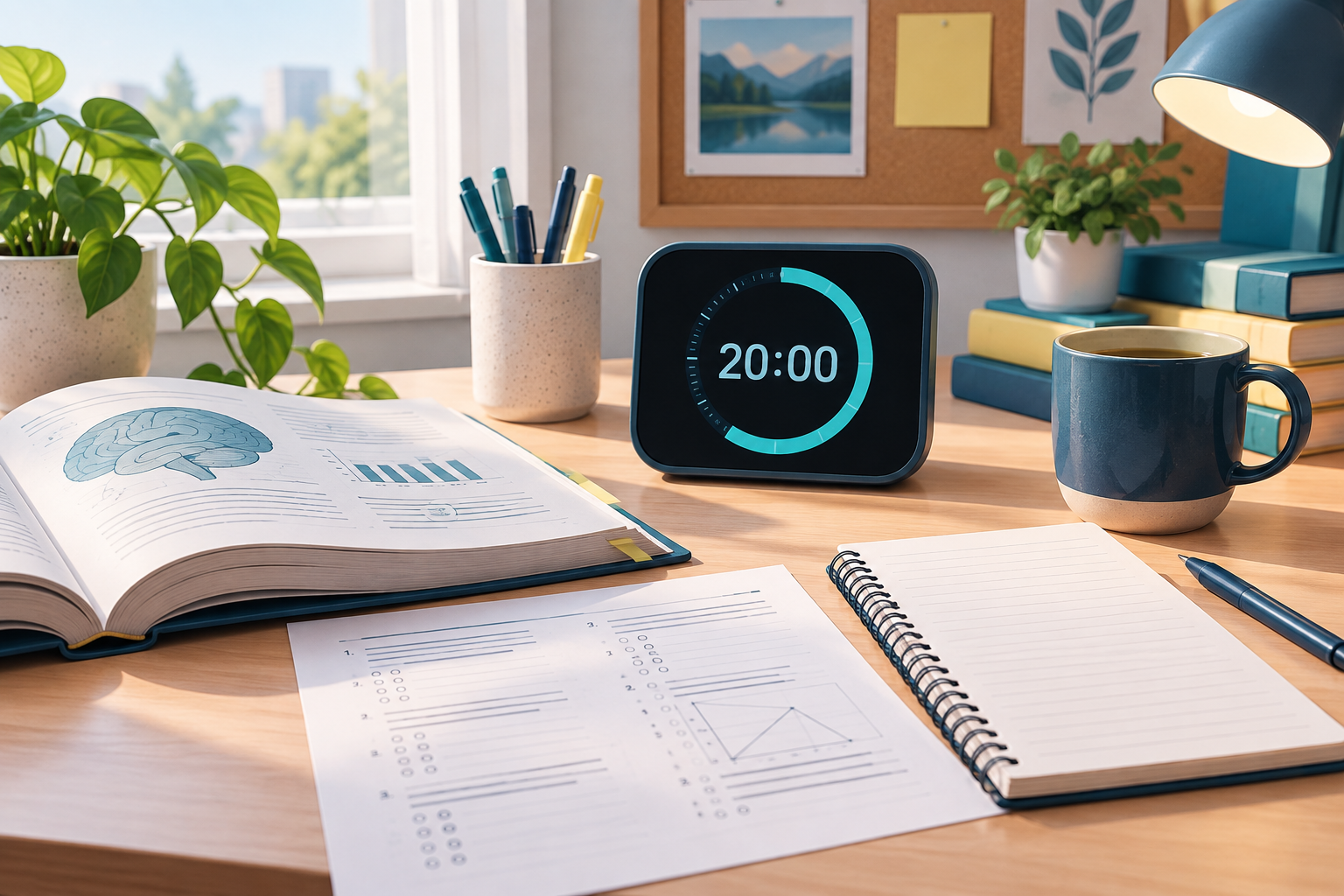
A 20 minute study timer is exactly what it sounds like: you set a timer for 20 minutes, focus on one specific task, and stop when it rings. No exceptions. No "just five more minutes."
After the timer ends, you take a short break (typically 5 minutes), then decide whether to start another session or call it done.
Think of it as micro study sessions that respect your brain's limits instead of pushing through them.
How It Differs from Pomodoro
If you've heard of the Pomodoro Technique, you're familiar with the concept. But there's a key difference:
- Pomodoro: 25-minute work sessions + 5-minute breaks
- 20-Minute Timer: 20-minute sessions + 5-minute breaks
Five minutes doesn't sound like much, but psychologically, it's huge. Twenty minutes feels manageable before you even start. Twenty-five can feel like a commitment. For students struggling with procrastination or ADHD, that perception matters.
The Science Behind 20-Minute Focus
Your attention span isn't what it used to be—and that's not your fault.
Research suggests the average human attention span for focused work ranges between 10 to 20 minutes before cognitive fatigue sets in. After that, your brain starts demanding novelty: a new tab, a notification, a mental break.
Why 20 Minutes Works
Dopamine regulation: Your brain releases dopamine when you complete tasks. A 20-minute session gives you frequent "wins," which keeps motivation high. Long study hours? You might not feel accomplished until hour three—if you even make it that far.
Cognitive fatigue prevention: Stopping before exhaustion means you're more likely to start the next session. If you drain yourself completely, you won't come back.
Attention span alignment: Twenty minutes sits right at the edge of natural focus capacity. You're working with your brain, not against it.
The magic isn't in studying longer. It's in studying before you hit the wall.
Who Should Use a 20 Minute Timer?
This technique isn't one-size-fits-all, but it works exceptionally well for:
ADHD students: Traditional long study blocks can feel overwhelming and impossible to start. A focus timer for studying that caps at 20 minutes removes the mental barrier of commitment.
Burned-out learners: If you've been grinding for weeks and retention is dropping, short sessions help you rebuild stamina without pushing harder.
Beginners who procrastinate: The hardest part of studying is starting. Twenty minutes doesn't feel scary. You can convince yourself to do anything for 20 minutes.
Long-hour studiers with low retention: Sitting at your desk for five hours doesn't mean you studied for five hours. If you're constantly distracted, short focus sessions with real concentration beat long sessions with divided attention.
Competitive exam aspirants: When you're preparing for JEE, NEET, UPSC, or any high-stakes exam, consistency matters more than heroic all-nighters. Twenty-minute sessions add up to serious volume over weeks.
How to Use a 20 Minute Timer Effectively
Using a timer isn't just about hitting "start." Here's how to make it actually work:
Before the Timer
Pick one clear task. Not "study biology." Try "memorize the Krebs cycle steps" or "solve five calculus problems."
Eliminate distractions. Phone on silent, in another room. Close unnecessary tabs. Tell people you'll be unavailable.
Set up your space. Water bottle, notes, pens—everything you need should be within reach.
During the Timer
Focus on one thing only. No multitasking. If another thought pops up, jot it down and return to your task.
Don't stop early. Even if you finish your task at minute 17, use the remaining time to review or go deeper.
Don't extend the timer. When it rings, stop. Even if you're in flow. Trust the system—you'll come back sharper.
After the Timer
Take a real break. Stand up. Stretch. Get water. Look out a window. Scrolling social media is not a break—it's another cognitive task.
Reflect briefly. Did you accomplish what you set out to do? What works? What doesn't?
Decide on the next session. You can chain multiple 20-minute blocks (try 3–4 in a row with breaks), or call it done. Both are wins.
20 Minute Timer vs Pomodoro: Which One Wins?
When to Choose Each
Choose 20 minutes if: You struggle to start, have ADHD or attention challenges, or feel constantly burned out.
Choose Pomodoro if: You're already comfortable with timed sessions and want slightly longer deep focus windows.
Honestly? Many students find they stick with 20-minute study sessions longer because the barrier to entry stays low, even on hard days.
Common Mistakes That Make Timers Fail
Even the best productivity timer for students can fail if you're using it wrong. Avoid these traps:
Overloading tasks: "Read 50 pages in 20 minutes" is a setup for failure. Keep goals realistic and specific.
No clear goal: "Study chemistry" is vague. "Memorize oxidation states of transition metals" is actionable.
Skipping breaks: Chaining ten sessions without rest will wreck your retention and motivation. Breaks aren't optional.
Chasing perfection: You don't need to understand everything perfectly in one session. Progress beats perfection.
How Academync Makes 20-Minute Sessions Stick
Here's a secret most productivity articles won't tell you: timers work better when you're not alone.
Studying solo with a timer is great—until motivation dips and you convince yourself to skip a session. That's where studying alongside others changes the game.
Some students find it easier to stay consistent when they're not studying alone. Platforms like Academync quietly support this by pairing short timers with shared focus rooms and accountability. You join a virtual study space, set your 20-minute timer, and work alongside other students doing the same thing.
No pressure. No conversation. Just the gentle presence of others who are also showing up.
It's not about hard accountability. It's about soft momentum—the kind that makes starting easier and quitting harder. When everyone around you is focused, you stay focused too.
Practical 20-Minute Study Schedules
Here's how different students use time blocking for students with 20-minute sessions:
Exam Prep (2 Hours)
- 20 min: Flashcard review (History dates)
- 5 min: Break
- 20 min: Practice problems (Math)
- 5 min: Break
- 20 min: Summarize weak topics (Science)
- 5 min: Break
- 20 min: Mock quiz
- 5 min: Break
- 20 min: Review mistakes
Coding Practice (1 Hour)
- 20 min: Learn new concept (video/documentation)
- 5 min: Break
- 20 min: Code the concept from scratch
- 5 min: Break
- 20 min: Debug and refine
Language Learning (40 Minutes)
- 20 min: Vocabulary (Anki/Duolingo)
- 5 min: Break
- 20 min: Writing practice or conversation
Revision Days (3 Hours)
- 20 min: Chapter 1 summary
- 5 min: Break
- 20 min: Chapter 2 summary
- 5 min: Break
- (Repeat for 3–4 cycles, then take a longer 20-minute break)
The key? Micro study sessions add up. Six 20-minute blocks equals two full hours of focused work—probably more real focus than most students get in a full day.
Start With Just One Session Today
You don't need to overhaul your entire study routine tomorrow. You don't need a complex system or perfect conditions.
You just need 20 minutes.
Pick one small task. Set a timer. Focus until it rings. Then take a break and notice how you feel.
That's it. That's the whole system.
The students who win aren't the ones who study the longest. They're the ones who study most consistently. And consistency doesn't come from superhuman willpower—it comes from making the work feel doable.
Twenty minutes is doable. Even on your worst days.
If staying consistent alone is hard, studying alongside others—even silently—can make a big difference. Whether you use a simple deep focus timer app or join a shared study platform, the goal stays the same: show up, focus, repeat.
Your brain will thank you. Your grades will follow.